Anybody and Everyone

We tend to see the words Somebody & Someone, Nobody & No-one, Anybody & Anyone, and Everybody & Everyone used as alternatives for each other.

I would like to propose that they are not, in fact, interchangeable.

My thinking starts from my belief that we are all infinite beings who have chosen (for reasons we can’t yet grasp) to have a Human experience. I somewhat inelegantly refer to our corporeal bodies as the “meat-suit” – it’s just a wrapper that makes it more convenient when interacting with all the other beings having a Human experience.

But, as infinite beings, we are really all a part of the One, the all-that-is, the universal consciousness, the Unified Field.

So in my writing, I choose to make a distinction between our Human being, the “meat-suit” and our spiritual being, the essence.

When referring to the Human, I use everybody, anybody, nobody. And when referring to the individual instance of the spiritual One, I use everyone, anyone, no-one.

Of course, in general usage, without having read this explanation, nobody consciously sees that distinction. But words have power when used with intention, and I suspect that everyone has an intuitive grasp of the distinction that I’ve chosen to make visible.

Try it in your writing and speech, it adds a new dimension of subtle communication and, I believe, conscious awareness.

The chances are that everybody will ignore my suggestion; and anyone – maybe everyone – might just choose to be more intentional with their words.

Illusions of separation

I’ve noticed for a while now that whenever I start writing, my natural inclination is to talk about what ‘we’ do, and how things affect ‘us’.

And copy-writers are always nagging me horribly about using ‘you’ instead.

Just lately I realised why that doesn’t sit comfortably with me – I don’t think of myself as separate from the rest of the world. We are all one. Or to be precise,  we are all expressions of one infinite being, doing a better or worse job of pretending to be separate.

Having said that, I expect I shall continue to talk to “you” in my published writing. It does seem to work better for attracting work and money.

I suspect that’s because the expressions of us who are best able to pretend to be separate are also those who are best at accumulating the bits and bytes we call money. Of course, that may be because we need that illusion of separation to believe in the scarcity that would make accumulating money a useful thing to do. I don’t know.

Be aware that I am not saying the people who are good at attracting money by pretending to be separate are in any way worse than those of us who struggle with being separate. I am certainly not assuming that they are unaware of their infiniteness and connection to all the other expressions of us.

They are simply behaving more like they are unaware, and for all we know they may be doing that consciously.  And if anything, that means they may be the superior beings, because they are better at playing the game.

Whatever the game is!

Photo by Grace Madeline on Unsplash

It’s all you …

Happy group of connected people enjoying life at sunset

If you really believe that you are an infinite being, then it follows that there cannot be anything that you are not.

So when you are seeing behaviour and beingness that you don’t approve of, it can only be an aspect of you. All the anger, meanness, greed, lack of caring, war-mongering, cruelty … all of that, all YOU.

Trump, May, Johnson, Corbyn, Putin, Kim Jong Un, even Farage … all aspects of *you*

Crazed jihadists, fundamentalist Christians, flat-earthers, and rabid priests of science … all aspects of you.

But don’t be too hard on yourself, you are also all the good things in the world – the mother’s loving smile, the baby’s chuckle, the artist’s fine appreciation of the world, the selfless caring of the relief worker – all you.

Everything you criticise or admire in “others” … all you!

And yet, we’re always being told to be compassionate towards others because we don’t know what’s going on in their lives. Surely if they are an expression of your infinite being, how can you not know?

The answer that works best for this particular expression of Us, the one experiencing being an English man in his 50s called Andrew Horder, is that we do know, we just choose, for some rather perverse and as yet unexplained reason, to close ourself off to the knowing.

So the question then becomes, what would it take for us to acknowledge that knowing?

And how might that make the world a better place?

Photo by Kevin Delvecchio on Unsplash

The Sin of Certainty

Uncertain looking woman

“… let me tell you that the one sin I have come to fear more than any other is certainty. Certainty is the great enemy of unity. Certainty is the deadly enemy of tolerance. … If there was only certainty, and if there was no doubt, there would be no mystery and therefore no need for faith.”

(Cardinal Jacopo Lomeli, in “Conclave”, Robert Harris)

That quote really jumped out at me when I read it on Christmas Day. It seemed to sum up so much of what is wrong with the world today.

Certainty is the great enemy of unity”. That makes sense to me; if one is certain about something, then only that thing can be correct. And all other opinions must be erroneous. Instant division – either right or wrong, nothing in between.

Certainty is the deadly enemy of tolerance.” Same thing – if you’re certain about something, you’re not going to be particularly tolerant of those who don’t share your view.  At best you’re going to pity them, at worst despise them. Again that separation into the right-thinkers and the wrong-thinkers.

The trouble with Certainty is that it’s an absolute; it doesn’t allow for any shades of grey between black and white, between correct and incorrect, between right and wrong. And my experience of the world is that it’s a technicolor dream, with every possible shade available, depending upon your particular perspective.

Remember that Facebook post, where someone got the world arguing about the colour of a dress? Was it black and blue, or white and gold? Each side was completely certain about their view, based on the empirical evidence they experienced. Only later did it come out that because we each process colour differently both views were capable of being correct.

So it’s not just the airy-fairy stuff like opinions, morals and ethics – and dare I say it, religion – that is subject to unreliable perceptions, and therefore doubt. We can’t even rely on what we can see with our own eyes.

And that brings me to the last part of the passage: “… there would be no mystery and therefore no need for faith.” We need to understand that the vast majority of our experience of this reality is based on our own perception.  That means we take pretty much everything on faith. That might be faith in some higher being, or faith in what we are told by scientists, or some combination of the two.  That’s for each of us to choose for ourselves.

Because unless we have observed the behaviour of the quantum particles of an atom for ourselves, and with our own senses (hint: not with an electron microscope – that uses the very things we’re using it to observe!), then we are reliant on what the priests of the science dogma tell us is going on. Just as the churchgoers of the middle ages were reliant on their priesthood for their understanding of the world. And as the warriors of ancient times were reliant on the medicine man to explain the things that they experienced.

We have faith in science. Or in religion. Or in mumbo-jumbo. Whatever works for you.

The problems come when the adherents of one set of priests start to believe that their lot have got it all right. In other words, when they become certain. Because that means they have to tear down the followers of all the others.

History has shown us that there’s always trouble whenever anyone thinks they have all the answers. And especially if they think they’ve found The Answer. Because then they feel they have to defend their Answer, and impose it on those too stupid to see it for themselves.  And some new knowledge or perspective always pops up later, proving them ‘wrong’.  The sensible ones back down, and shuffle, shamefaced, into the canon of ‘people who got it oh so wrong’. The less sensible battle on, desperate to save face, thus taking the world into dangerous schisms, and even into war.

If you ask me, so far at least, only one entity has ever got The Answer right.  The Deep Thought computer (in Douglas Adams’ Hitchhiker’s Guide to the Galaxy) said the answer to life, the universe, and everything is 42 – which just happens to be the ASCII code for the asterisk. Which happens to represent, well, whatever the hell you want it to be!

To me, the mystery that pervades all of life, that uncertainty about the world, that doubt that makes faith necessary, that’s what makes the world such fun. If there was one single, certain truth, then there would be one single, certain, inevitable way to get on in the world.  Like robots – or denizens of The Matrix.

And I thank God, Yahweh, Allah, Gaia, Spirit, and the Scientists – that there isn’t.

Because that would be so boring!

.

Photo by Léa Dubedout on Unsplash

Maybe time really is flying?

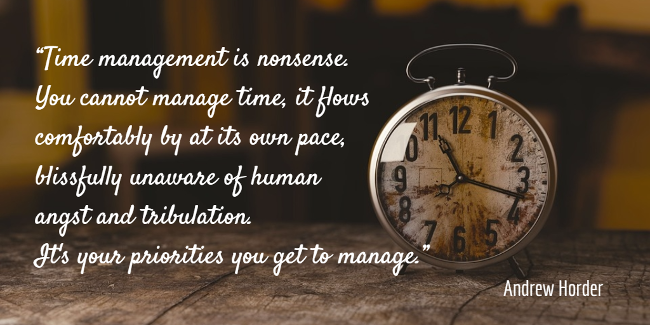
Time management is nonsense

Do you remember when you were a child and sometimes a day felt like a week and a week felt like a year, because the possibilities felt so endless, and the adventures you could have were so vast and varied?

During my morning meditation the other day it occurred to me that what if, as infinite beings having a human experience, what we see as a lifetime is really, in the context of the existence of an infinite being, just a day or so of grand and glorious adventures?

What if for our real selves, the things we allow to upset and frustrate our human selves are like those little tears and tantrums we experienced as human toddlers? And instantly forgot when the cookie jar opened, or we found something else to explore.

What if, to our infinite selves, the world is one big cookie jar, open and ready to sustain us as we venture out into this brief reality with gleeful curiosity?

How much joy could we spread then?