Conspiracy Theorists – please stop using the Biased Expert Fallacy

conspiracy theories - kid with telescope

Conspiracy Theorists – please stop using the Biased Expert Fallacy

It’s lazy, it insults the reader’s intelligence, and most importantly, it’s unethical.

The very best way to ensure that I don’t take seriously your warnings about your favourite conspiracy theory is to suggest, without clear evidence, that the regulator must be in cahoots with the industry/government. As soon as I see or hear that in a presentation, my bullshit detectors are on full alert.

What is the Biased Expert Fallacy?

We’ve all seen it – a regulator’s credibility is called into doubt because they used to work for one of the major companies in the industry they are now responsible for overseeing.  The implication being that because they are a “poacher turned gamekeeper” they will be unduly biased towards their former colleagues in the industry.

Assumptions – (they make an Ass out of U and Me)

That makes two very big assumptions: firstly that someone who has been in an industry can’t object to some of its less savoury practices; and secondly that simply having worked in an industry that you’re now regulating somehow automatically makes you dodgy. There is no rational reason to believe either of those things.  The first is simply illogical, as I will explain in a moment. The second is just insulting to the vast majority of regulators, most of whom do a spell in industry before crossing the divide into regulation.

Bordering on the libelous

A more pernicious form of the fallacy is to then go and suggest that the regulator is somehow ‘in the pocket’ of the big players in an industry. Or worse (and regrettably we see this all too often around the ‘alternative news’ and ‘truth warrior’ sites), questions are asked about whether the individual regulator is taking back-handers for their approvals, or for turning a blind eye.

And all that is typically wrapped up in a cowardly, arse-covering cop-out like “I’m not saying this is so, but just ask yourself …” Theorists, if you really believe somebody is on the take, have the courage of your convictions and make a straight accusation, don’t wrap it up in plausible deniability crap to save yourself from getting sued for your slanderous bile. That’s just cowardly.

To be clear, I’m not talking here about industries in which the regulator is voluntarily funded by the participants. There is a very clear ‘agency problem’ with that arrangement – which is why a number of the more questionable industries opted for voluntary regulation before it got foisted on them by statute. I’m talking about accusing individuals of malfeasance with no evidence whatsoever.

But I digress.

Why we need expert regulators

The people best placed to know whether individual players within an industry are up to something undesirable, are the very people who understand the industry. Experts who know that a particular process cuts corners or carries dangers that the layman wouldn’t recognise.  And who better to know the corners that get cut, than someone who has been on the inside, seen it first hand and decided to do something about it?

Someone on the inside

As I said earlier, the Biased Expert fallacy assumes that nobody from an industry can object to its dodgy practices. But surely it’s equally likely that an industry insider who then joins the regulator will be doing so precisely because they are concerned about dodgy practices, and they want to control them without risking their livelihood.

These insider experts know where to look, they know the questions to ask, they recognise incomplete answers, and they know how to spot abuses as they are happening.

The end-game

So what happens if the Biased Expert fallacy is allowed to take hold? The logical end-point is that no regulator will ever employ someone from within the industry, for fear of their credibility or impartiality being challenged. Or, at best, no-one from within the industry could ever rise to head up a regulatory body – which is not exactly going to encourage quality recruitment to regulatory positions.

We then end up with toothless and incompetent regulators, around whom the miscreant players can run technical rings, baffling them with industry jargon that the regulator isn’t up to speed about.  Sure, we can employ academics as regulators, after all, they should be at the cutting edge of the technology and theory.  But there is no substitute for someone who has actually been at the coal-face and can call bullshit on excuses and justifications.

Regulators with good intent

My biggest issue with the excessive use of the Biased Expert Fallacy is that it comes from a place of assuming wrong-doing. Anyone who has been employed in an industry is assumed to be crooked, or at least looking out for their mates, not the public. And heaven forbid that they should have been successful in the industry, and risen to any position of power – now they absolutely must be dodgy to want to join a regulator!

Whatever happened to innocent until proved guilty?

Damaging credibility (yours, not theirs)

Lazy conspiracy theorists all over are making the same mistake, of accusing potentially well-meaning regulators of self-interest purely on the basis that they have worked in the industry they are regulating. That results in a great many such accusations being defeated through simple lack of evidence. Or worse still, through evidence to the contrary.

And that’s a real problem for those of us who wish to challenge the accepted paradigms and are open to exploring whether the path(s) the world is on are in fact the best ones for humanity and the planet. Because every false accusation, every lazy assertion, every claim that doesn’t have adequate basis in demonstrable fact, each and every unjustifiable cry of “Wolf!” makes it harder for the real good guys to expose the real bad guys.

It’s lazy, it’s ineffective, and it harms your cause. Stop it.

Automation and the death of employment

I’ve been pondering some more about how automation and AI are going to affect the world of work. One question that’s come to mind is: should we expect business owners to share the benefits of automation with their employees?

I’ll say right at the outset, I don’t have the answer, and this is in many ways a simplistic and naïve view of innovation. It’s not intended to be a scholarly article, more a sharing of concerns and something I invite other greater minds to both tear down and contribute to.

Buckminster Fuller’s vision of a world in which labour is no longer required is, it seems to me, predicated on the benefits of the labour-saving inventions being shared by the whole of society. Greater productivity means that overall we all have to work less to get the same output, and that should mean we all have more ‘leisure’ time (or at least time not involved in production of our physical needs & wants).

So let’s bring that down to the level of a single business. The owners calculate that an investment in automation will allow them to produce the same quantity of goods with fewer employees on the production line. By having fewer worker hours to pay for, they can recoup their investment in a certain period of time. For most businesses, that’s likely to be maybe a 3-5 year payback period, after which the automation adds profit straight to their bottom line.

That’s how it works with the current shareholder-led system, with all the gains accruing to the business owners.  Great for business owners – less hassle from employees, and after the payback period, more profit. But it’s not so great for the workers who get laid off.

There is still a need for the same amount of production, but now we need fewer worker-hours to produce that. We have choices to make, at a societal level, about how we handle that situation in a way that is fair to everyone and doesn’t simply throw workers on the scrap-heap of things that have been superseded by technology.

The business still has an amount of revenue coming in, but fewer hours are needed to produce it.  One option might be to still pay the workers the same salary, giving them time off to do other things. That would have the benefit of avoiding unemployment, and of enhancing workers’ lives. The downside is it could take away the business-owners’ incentive to invest in improved productivity in the first place.

Or we might say that as the employer now only needs to purchase a certain number of hours labour, those hours should be shared out equally between all the existing workers. The benefit is nobody is thrown on the scrap-heap, they all still get to be useful, and they all still get to earn.  A downside is that all the workers’ incomes would fall, possibly to an unsustainable level, putting more of them into the benefits system.

In the current arrangement, the business-owner makes the investment, and the workers suffer the reduction in jobs.  In the first option above, the business-owner carries the cost (putting in the automation) and the workers get all the benefit (shorter working hours). In the second, the workers take all the pain, having less in wages to share between them, and the business-owner gets all the extra profit.

Some might say that it’s right that the owners get all the profit – after all, they made the investment. And in classic capital-led economics, that would be correct. But the problem is, only the owners get to make that choice.  The workers have the choice thrust upon them. Under current rules, the owners take the lion’s share of the gain and the workers take pretty much all of the pain. For a choice they didn’t make.

Maybe what we need is a way for the workers to have a say in how automation is applied, to share in the gain, and to choose to share in the pain. Maybe during the payback period they take a lower wage, investing in their own future by contributing to making the investment worthwhile for the owners. But that’s only ever going to work if it’s a choice they make themselves.

From there, we get into the unique and potentially vastly different situation of each worker. The young man at the beginning of his family life, with kids in school and a big mortgage, is going to be less able to take a drop in his income than the guy who’s approaching retirement and has paid off his home loan. And even that is a massive over-simplification.

I don’t know the answer. But I do know that the current ‘owner-takes-it-all’ approach to automation will create enormous problems for society as a whole, and for the ‘working classes’ (whatever that means these days) in particular. Failing to deal with it will almost inevitably lead to massive social unrest, as jobs become increasingly scarce. It is not an issue we can afford to ignore, and we cannot leave it to capital-funded* government to resolve it.

I’d love your views – share them below, or use this as a conversation-starter on social media. The more we talk about it, in an open an respectful manner, of course), the better the solution that emerges.


* That’s a whole other article, but make no mistake, governments are not funded by taxation of their citizens. Taxation only occurs because of commerce, and commerce is funded and controlled by capital.

Photo by Daniel Apodaca on Unsplash

It’s all you …

Happy group of connected people enjoying life at sunset

If you really believe that you are an infinite being, then it follows that there cannot be anything that you are not.

So when you are seeing behaviour and beingness that you don’t approve of, it can only be an aspect of you. All the anger, meanness, greed, lack of caring, war-mongering, cruelty … all of that, all YOU.

Trump, May, Johnson, Corbyn, Putin, Kim Jong Un, even Farage … all aspects of *you*

Crazed jihadists, fundamentalist Christians, flat-earthers, and rabid priests of science … all aspects of you.

But don’t be too hard on yourself, you are also all the good things in the world – the mother’s loving smile, the baby’s chuckle, the artist’s fine appreciation of the world, the selfless caring of the relief worker – all you.

Everything you criticise or admire in “others” … all you!

And yet, we’re always being told to be compassionate towards others because we don’t know what’s going on in their lives. Surely if they are an expression of your infinite being, how can you not know?

The answer that works best for this particular expression of Us, the one experiencing being an English man in his 50s called Andrew Horder, is that we do know, we just choose, for some rather perverse and as yet unexplained reason, to close ourself off to the knowing.

So the question then becomes, what would it take for us to acknowledge that knowing?

And how might that make the world a better place?

Photo by Kevin Delvecchio on Unsplash

The Sin of Certainty

Uncertain looking woman

“… let me tell you that the one sin I have come to fear more than any other is certainty. Certainty is the great enemy of unity. Certainty is the deadly enemy of tolerance. … If there was only certainty, and if there was no doubt, there would be no mystery and therefore no need for faith.”

(Cardinal Jacopo Lomeli, in “Conclave”, Robert Harris)

That quote really jumped out at me when I read it on Christmas Day. It seemed to sum up so much of what is wrong with the world today.

Certainty is the great enemy of unity”. That makes sense to me; if one is certain about something, then only that thing can be correct. And all other opinions must be erroneous. Instant division – either right or wrong, nothing in between.

Certainty is the deadly enemy of tolerance.” Same thing – if you’re certain about something, you’re not going to be particularly tolerant of those who don’t share your view.  At best you’re going to pity them, at worst despise them. Again that separation into the right-thinkers and the wrong-thinkers.

The trouble with Certainty is that it’s an absolute; it doesn’t allow for any shades of grey between black and white, between correct and incorrect, between right and wrong. And my experience of the world is that it’s a technicolor dream, with every possible shade available, depending upon your particular perspective.

Remember that Facebook post, where someone got the world arguing about the colour of a dress? Was it black and blue, or white and gold? Each side was completely certain about their view, based on the empirical evidence they experienced. Only later did it come out that because we each process colour differently both views were capable of being correct.

So it’s not just the airy-fairy stuff like opinions, morals and ethics – and dare I say it, religion – that is subject to unreliable perceptions, and therefore doubt. We can’t even rely on what we can see with our own eyes.

And that brings me to the last part of the passage: “… there would be no mystery and therefore no need for faith.” We need to understand that the vast majority of our experience of this reality is based on our own perception.  That means we take pretty much everything on faith. That might be faith in some higher being, or faith in what we are told by scientists, or some combination of the two.  That’s for each of us to choose for ourselves.

Because unless we have observed the behaviour of the quantum particles of an atom for ourselves, and with our own senses (hint: not with an electron microscope – that uses the very things we’re using it to observe!), then we are reliant on what the priests of the science dogma tell us is going on. Just as the churchgoers of the middle ages were reliant on their priesthood for their understanding of the world. And as the warriors of ancient times were reliant on the medicine man to explain the things that they experienced.

We have faith in science. Or in religion. Or in mumbo-jumbo. Whatever works for you.

The problems come when the adherents of one set of priests start to believe that their lot have got it all right. In other words, when they become certain. Because that means they have to tear down the followers of all the others.

History has shown us that there’s always trouble whenever anyone thinks they have all the answers. And especially if they think they’ve found The Answer. Because then they feel they have to defend their Answer, and impose it on those too stupid to see it for themselves.  And some new knowledge or perspective always pops up later, proving them ‘wrong’.  The sensible ones back down, and shuffle, shamefaced, into the canon of ‘people who got it oh so wrong’. The less sensible battle on, desperate to save face, thus taking the world into dangerous schisms, and even into war.

If you ask me, so far at least, only one entity has ever got The Answer right.  The Deep Thought computer (in Douglas Adams’ Hitchhiker’s Guide to the Galaxy) said the answer to life, the universe, and everything is 42 – which just happens to be the ASCII code for the asterisk. Which happens to represent, well, whatever the hell you want it to be!

To me, the mystery that pervades all of life, that uncertainty about the world, that doubt that makes faith necessary, that’s what makes the world such fun. If there was one single, certain truth, then there would be one single, certain, inevitable way to get on in the world.  Like robots – or denizens of The Matrix.

And I thank God, Yahweh, Allah, Gaia, Spirit, and the Scientists – that there isn’t.

Because that would be so boring!

.

Photo by Léa Dubedout on Unsplash

Step away from the sound-bite, Sir!

Ever since Facebook introduced the ability to make a short status update look more interesting by putting it in big text on a pretty colour background, I have noticed an increasing tendency for people to put up short provocative posts.  And many of these posts provoke quite a lot of discussion – I suspect that’s the aim, to increase FB reach by tricking the algorithm into thinking the original poster has created something of value to the other platform users. After all, loads of them responded, didn’t they?

And, to a large extend, the algorithm is right.  More responses does mean the audience think the post was worth commenting on. Even if, as is often the case, to say it’s utter bollocks.

I would love to be able to say that the problem is that both the algorithm and the people commenting are rewarding behaviour they don’t really value. Because no-one sees value in truncated click-bait provocation with no thinking behind it, do they?

Except that’s not the case. As far as Facebook is concerned, pretty much ANY interaction with the platform is good. Unless it’s a baby with a nipple in its mouth, but that’s a whole other issue. Because people doing stuff on FB are people it can show ads to. WE are the product folks, never forget that!

That the algorithm rewards crap posts is bad enough. But the worse thing is that the people who respond are ALSO rewarding crap posts BECAUSE THEY LIKE THEM.  Posting sound-bite nonsense is serving a certain part of the FB community by giving them something to pontificate about.

Facebook is a great place to have a go at people, and to demonstrate our superior intellect/financial position/business acumen/spirituality/consciousness/general worthiness (select all that apply). So people posting poorly-thought-out click-bait are providing us with an opportunity to make ourselves look good.  And the fact that we get to do it at the expense of someone a bit dim – well, that’s even better, isn’t it?

Don’t get me wrong. I’ve had a lot of very good conversations on Facebook (and other social media), where we‘ve been able to fully explore a controversial subject in quite some depth.  Most of those discussions have led to me understanding more about the world, and the shallowness of my previous grasp of the topic.  So I’m not saying there’s no value to arguing on Facebook (though it must be said that Mrs H disagrees – frequently).

But very few of those meaningful conversations have started from a brightly-coloured sound-bite click-bait post.

When the opening post has some depth (even if it’s deeply erroneous, in my world-view), those who bother to read it tend also to have sufficient depth of appreciation of the topic to bring cogent arguments to the discussion.  There’s less ‘yah-boo’ and ad hominem, and more reasoned and courteous argument – which is, in the end, what changes minds and informs debate.

The danger is that we become so used to the click-bait stuff, and get so much fun out of scoring silly points in a shallow and divisive argument, that we leave ourselves insufficient time to think deeply about anything.  And that harms the whole of society.

So please think before you respond to a click-bait provocation: would my time be better spent finding someone to engage with who can actually be bothered to develop a cogent thought?

I suggest that we all start right now to boycott all posts that seek to distract us with psychedelic  backgrounds and pithy, but essentially empty, sound-bites.

Maybe time really is flying?

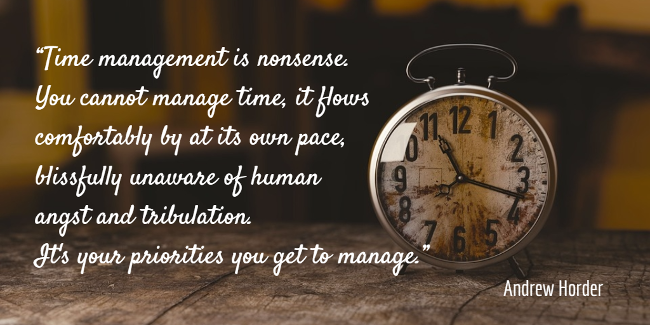
Time management is nonsense

Do you remember when you were a child and sometimes a day felt like a week and a week felt like a year, because the possibilities felt so endless, and the adventures you could have were so vast and varied?

During my morning meditation the other day it occurred to me that what if, as infinite beings having a human experience, what we see as a lifetime is really, in the context of the existence of an infinite being, just a day or so of grand and glorious adventures?

What if for our real selves, the things we allow to upset and frustrate our human selves are like those little tears and tantrums we experienced as human toddlers? And instantly forgot when the cookie jar opened, or we found something else to explore.

What if, to our infinite selves, the world is one big cookie jar, open and ready to sustain us as we venture out into this brief reality with gleeful curiosity?

How much joy could we spread then?

Don’t be fooled …

The new US President is no fool.

It seemed inconceivable even as little as 6 months ago that he could really become POTUS.  A loud, ignorant, brutish man, with little political savvy and even less sense of decorum.  And yet, here we are, with Executive Orders seeing long-term, legal, US residents getting removed from their flights home, and facing a three month wait before they can return, if ever.

But do not make the mistake of believing that Donald J Trump is an idiot. He has made a career – and a fortune – out of a negotiating style that uses bluff and bluster, and not a little sleight of hand, to get his way – to enrich himself.  This is what he has brought to the White House.

With his close team doing all manner of strange things, from eviscerating departments to describing blatant untruths as “alternative facts”, or seemingly mistaking a living civil rights leader for his dead father, we are kept on the hop. We just don’t know what’s real any more – and that’s the way they want it.

I would urge you to take a look at the similarities with the way Vladislav Surkov has used misdirection and confusion to hobble opposition to Russia’s President Putin (see http://clamour.co.uk/surkov-and-the-politics-of-confusion/ for more).  Trump’s team are showing many signs of using similar tactics; he may not be sophisticated, but he is not stupid.

When we focus on Sean Spicer’s (apparent) incompetence, or on Trump’s (apparent) thin skin; when we make pejorative reference to his (apparently) tiny appendages, or his (apparent) ire about unflattering photos; when we call him things like “orange man-child” (amusing though that is) – when we do any of that, we are playing into his hands, and allowing ourselves to become focused on the minutiae.

This level of “resist-and-react” opposition is not going to work. A pull back to the previous political landscape is destined to fail – the old politics was already failing, that’s why we needed a Trump, and we cannot go back.  The only way forward from here is to a different politics altogether, one where people of like mind can come together for particular issues, then dissolve and regroup in different ways, to create other things that matter. The days of bi-partisan “align-and-agree” are numbered.

Make no mistake, one way or another, we are watching the end of the current form of democracy.  It can go many ways from here – to a Trumpian dictatorship designed to enrich just an oligarch class of billionaires, or to a utopian experience of universal care and compassion that enriches the whole of mankind on many levels. Or anything in between – and how it pans out is up to us.

Just don’t underestimate The Donald – that would be a dangerous mistake.

Living the dream?

I just read The Dream Manager by Matthew Kelly – it’s a nice little tale of a business that wakes up to its role in helping the people who work for it to be the best version of themselves they can be.

The way they do that is by appointing a “Dream Manager” whose job is to help employees to first dream up, and then realise the things they really want from life.  In the story, that’s everything from owning their own home to simply having a proper Christmas.

It got me thinking – maybe the real reason organisations exist is not, as I have thought up until now, to help people bring their talent to the world, but simply to help them be happy.  Of course, they can probably be happier if the work they do is intrinsically meaningful, but perhaps this ‘dream manager’ approach is a good way to deal with those who find themselves having to do mundane work.

What do you think?

What are organisations really for?

This is something I’ve been thinking about for a while – I think modern organisations – especially corporate ones – have forgotten what they are really for.

History of organisations

Back when people started to organise into collaborative groups, aka tribes, the purpose was initially strength in numbers. Over time, individuals gravitated to the tasks they were best at; and the tribe came to rely on them to get that task done. Whatever someone had a penchant for doing, so long as the tribe found that activity useful in some way – including pure entertainment value – the tribe would adjust itself to allow ways for each person’s special talent (or Genius, in my lexicon) to be used as fully as possible.

As tribes became cultures, and then societies, and then economies, they became too large to operate as a homogeneous whole, and they split into smaller units, each with a need for certain tasks too be carried out, and opportunities for those with a penchant for those tasks to provide value by doing them.

The first real commercial organisations were the crafts guilds, providing a way for talented people to learn a trade and bring their value to the world. From these came small businesses, with a Master taking on Journeymen and Apprentices – still with the purpose of making it possible for the individuals to bring their genius and value to others.

Rise of the Company

Then, at a certain point in history, mechanisation meant that if someone made a large investment in machinery, it was possible to generate more value from the same number of workers. And that was when the focus shifted from collaboration aimed at helping the individual’s talent reach the customer, to organisation aimed at getting the most from the machines in which the owners had invested their capital. Getting a return on capital took over as the primary concern; capitalism had arrived.

For a long time, capitalism played a valuable role in fuelling human development, and made significant contributions to improving mankind’s lot. The returns expected by the owners of the capital seemed justified, given the contribution they were funding to a better life. People stopped dying of preventable disease (in the developed world at least), and life-spans grew longer.

Shareholder Focus

Somewhere along the way, some bright spark had the idea of getting lots of people with money to each put in a bit of capital to buy machinery, build factories, develop new products, all in exchange for a share in the company – in the form of share certificates. So now, instead of one beneficial owner with a clear vision of what the business is there to do, there are multiple owners, who may or may not agree on its purpose.

Add to that the fact that these multiple owners then worked out that if you could get a nice return from a share in one business, you could probably do even better with shares in several. So each owner’s focus became less clear too – a recipe for confusion about what each business was supposed to be achieving.

Trading away purpose

And then another bright spark came up with the idea of an “exchange” where you could sell your shares, so now investors could easily get away from their involvement with the companies if they became irksome to them, or if things started going a bit pear-shaped. And yet another bright spark came up with the idea of putting your spare money (capital) into a “fund” that someone else would run, investing your money for you, in lots of different companies. And finally, a whole bunch of bright sparks came up with the idea of “derivative” investments, so they weren’t even investing in companies at all!

At every stage, ownership and control moved further away from any connection with what the business was actually for. Investors are no longer nobly contributing to something they want to see getting out into the world, they are just too far removed from what’s actually going on inside the companies. The only way they can know if their money is being used effectively is by the amount of profit they see getting paid out as dividends. The profit motive has now usurped the proper purpose of a business.

Real purpose

I believe if you go back to the origins of organisations, the proper purpose of any organisation, whether commercial, public sector or charitable, is to enable those who work in it to use their skills, talents and unique genius to make the world a better place for some group of other people – whether that’s by designing and building smart motor cars, by putting on amazing and amusing entertainment, or by providing the wherewithal to bring clean water to communities in the developing world.

And my question is: how can this true purpose retake the primacy that the profit motive usurped?

Has technology been holding us back?

I was participating today in an Access Consciousness vision body process class, and we were discussing how maybe being issued with glasses was making our eyes lazy, relying on the corrective lenses rather than strengthening their own ability to correct weakness.  That got me thinking about all the other tech we have come to rely on, to help us do stuff we don’t think we can do without it.

What if all this tech as actually just getting in the way of us finding more natural, innate ways to do what we have turned to tech for?

Continue reading “Has technology been holding us back?”